Update 3/30/2026
Reflection on war stories

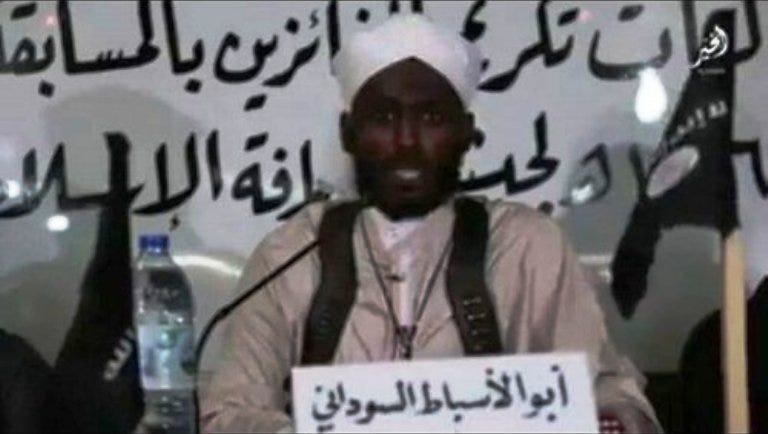
Ali Abdul-Ma’ruf aka Abu al-‘Asbat al-Sudani, emir of prisons in Mosul, killed there in 2017. He was one of many Sudanese jihadists over the past four decades.
I’m back home, so content will resume at the regular schedule. Before my break, I had said that I would publish my recent correspondence with “Flow” and begin serializing Abu Hamza al-Muhajir’s biography. This is still the plan–the correspondence will be published this week, and Muhajir’s biography is in the queue. But plans change. Recently, a Twitter user (mtb1261434) kindly shared the fascinating narrative of a Sudanese veteran of the Iraqi Insurgency and later of ISWAP in Nigeria (not the individual pictured above). The narrative is reported by an “Adnan Absi.” I was initially skeptical, as the story seemed “too good to be true,” so I asked some jihadist sources for their take on it. They told me that the narrative is highly plausible, though unlikely to ever be truly verified.
This is the case with most jihadist narratives. We simply have to trust that the authors are reporting the truth. I’ve found that the narratives are usually reliable even if we can never know for certain. Every researcher wishes that the sources were all written down and judiciously cited or corroborated, but that isn’t how life works. People aren’t alive so some researcher can one day write about it. Some things aren’t meant to be written, only shared by word-of-mouth. Of whatever that can be written, not all of it can be cited or corroborated. This doesn’t make these narratives any less true, and I think society is better off with information being passed down in this somewhat fragmentary manner. It forces us to engage with the past as something alive, not as a sterile book or article. There’s nothing wrong with a well-done work of research, but it will always feel lesser to learning the “facts,” as it were, from an eye-witness, whether in a narrative like Adnan Absi’s (or the Distinguished Martyrs series), or over a conversation. We have to meet and get to know those who came before us, to earn their respect, and to finally be gifted with what they know.
J. Sakai calls this phenomenon “old war stories” in his book on the lumpenproletariat. One such story, says Sakai, was that some fighters in the Ernst Thalmann Battalion in the Spanish Civil War were ex-Sturmabteilung members, or “beefsteak Nazis,” who had been purged in the Knight of the Long Knives. In the accompanying footnote, Sakai writes:
Our esteemed editor insists that this point in the text must be footnoted and a reputable source provided, since it goes so contrary to left history and would be so controversial. The only problem is really, i don’t want to do it. Kind of treasure this as an old war story. These are an important “off the record” part of everyone’s culture. When i was a little kid, in the summer the young guys in my family and their friends would gather in the long dusk on the back porch, after their day at the auto garage or factory. Drinking bottles of beer, smoking cigs whose packs they had rolled up in their white t-shirt sleeves, arms dark with summer tan laughing and ribbing each other about young escapades back in what my parents generation always just called “camp”–that’s the Japanese American concentration camps they had us in–as well as the crazy stuff that happened after that in Italy or somewhere with the all-Jap 442nd regimental combat team in World War II. Old war stories. My kiddie ambition was to grow up to be one of those sexy working class guys dissing and laughing with each other.
In the movement. “old” Trotskyists and Stalinists (some really aged, like in their 40s even!) would hang out with fresh caught kids like me. Telling us inside dope about union history and famous left personalities and what really happened here and there. All not like the cleaned up versions publicized in left lit. Old war stories. Owe a lot to that grassroots custom, and value it still. So am just going to consider that Spanish Civil War episode (which i got from the horse’s mouth, as they put it) an informal old war story, too. You can criticize it as “can’t be true” or whatever you want, that’s okay. Don’t blame the poor editor.
I choose to believe Sakai, do you? All of this is to say that I will serialize Adnan Absi’s narrative over the next few weeks. It blends together the two main subjects of this page–the Iraqi Insurgency and West African jihadism–so it can’t be considered a digression. I hope you enjoy.