
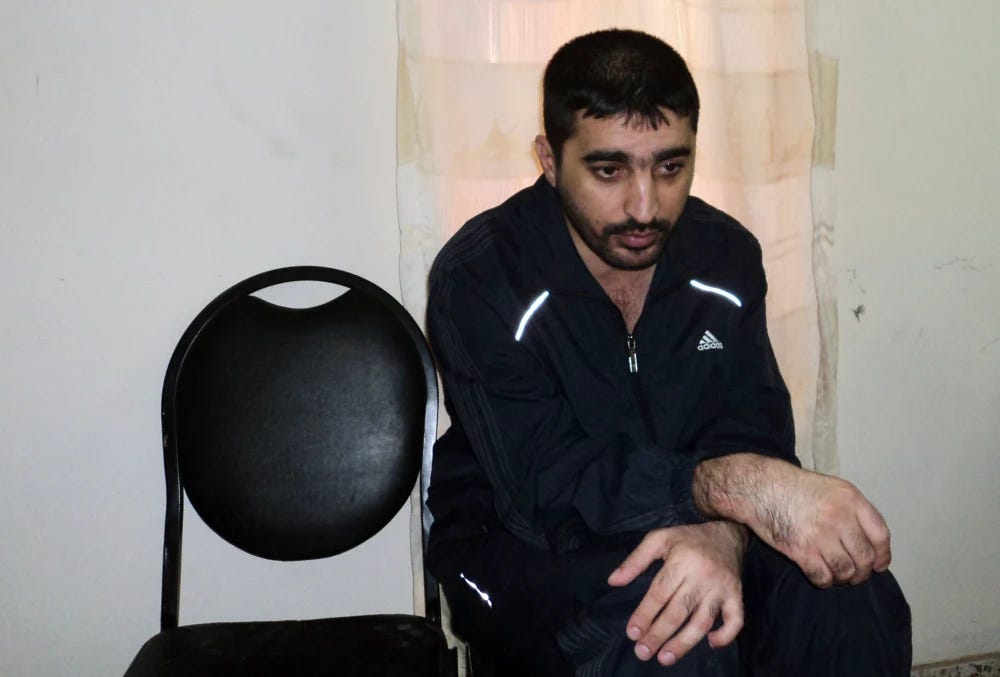
Manaf al-Rawi giving an interview after his arrest
Perhaps the most puzzling figures in Islamic State history is Manaf al-Rawi. He was part of the movement from its earliest days in Iraq, having joined the Rawah Camp early on and trained alongside its founders and its ~100 recruits. During this time, he was in close proximity to Abu Musab al-Zarqawi’s inner circle, which he would eventually join outright. He later fought in the First Battle of Fallujah. While in Fallujah, Manaf was among the five men who beheaded Nick Berg. He is the figure second from the left. Later in the video of the execution, he is even the one who holds up Berg’s severed head.
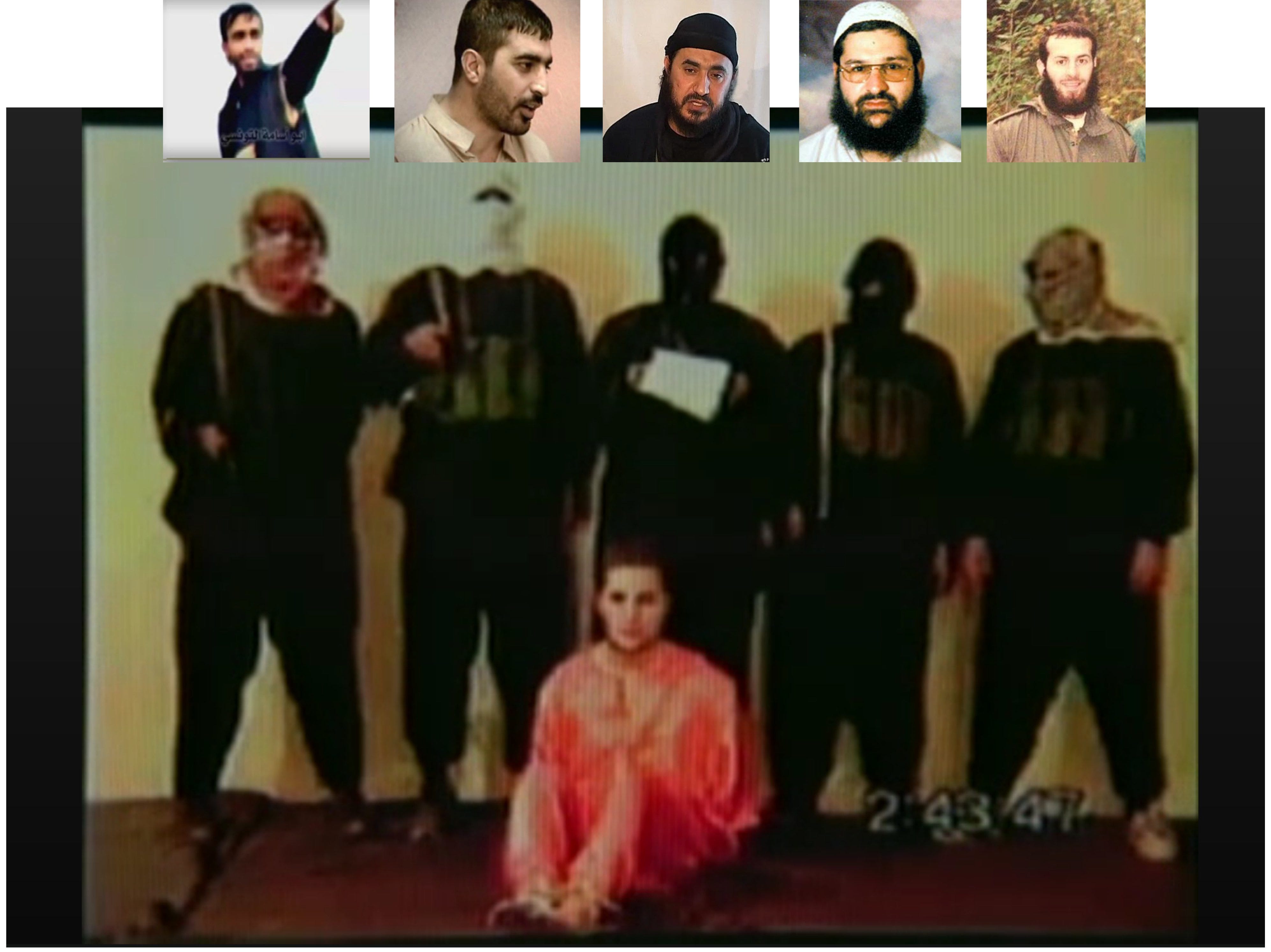
Image credit to Daniele Raineri
Manaf was eventually arrested in Fallujah and sentenced to prison in mid-2004. In his first prison sentence, he was a senior figure for the Zarqawists and worked to ensure their dominance over other prison factions. After his release in 2007, he became the wali, or governor, of Baghdad, where he led a devastating campaign of mass-casualty strikes, oftentimes killing and wounding several hundred people at once. In 2010, he was again arrested, but this time, he betrayed IS and supplied the intelligence that led to the deaths of Abu Umar al-Baghdadi and Abu Hamza al-Muhajir, the two co-leaders of IS at the time. The exact reason for his betrayal–after many years of fanatical service to the jihadists–is still unclear.
Strangely, Manaf remains highly celebrated in IS history. In a recent biography of IS’s third “caliph,” Abu al-Hassan, Manaf is respectfully called “Shaykh,” and Abu al-Hassan’s proximity to him–first in Rawah, then in Fallujah, and lastly in Camp Bucca–is stated as a credit to Abu al-Hassan’s prestige. Another example of Manaf’s lasting “celebrity” within IS is the first source below. It is a memoir of Manaf written by his friend, Abu Abdullah al-Sunni al-Kurdi (a Kurdish jihadist). The memoir focuses on the two individuals’ shared time in prison during Manaf’s first sentence (2004-07), and it reveals a great deal about IS activities behind bars in general and Manaf’s ideological fanaticism in particular.
Abu Abdullah reports several notable incidents. First, Manaf led a prison riot that began in protest of US camp guards ripping up the Quran. The guards shot down the rioting prisoners, killing and wounding over a dozen, and Manaf himself fought for an hour under gunfire. He was later involved in fierce prison rivalries with other factions, especially one non-jihadist group, contemptuously called the Murji’ah. Abu Abdullah recounts that Manaf brutally attacked one member of this group for his “insolence” against the jihadists. Manaf also threatened a supposedly “pro-Shiite” rival, Mahdi al-Sumayda’i, against preaching in their shared compound, successfully halting his political activities. However, the most interesting incident is an attempted prison break. Manaf and several other prisoners secretly dug a tunnel underneath the prison to eventually escape. The diggers were Sunni Arab Iraqis, but the plan–as laid out by Manaf and the others–was for the Kurdish and foreign Arab jihadists to escape first, then for the diggers to escape. The plan failed, but Abu Abdullah was eventually released from prison before Manaf, and the two would never see each other again. Manaf would be released some time later and became the wali of Baghdad, leading a brutal campaign during 2008-10 before his final arrest and prison sentence.
It was during this second sentence that Manaf would be interviewed by Iraqi and international media, one of which (with al-Iraqiya news) is the second source below. Something immediately apparent in the interview is Manaf’s lack of repentance for his actions. In the first question, he is asked whether he thinks about his victims while watching footage of his attacks on television, and he retorts that he “does not watch television.” In the last question, he is asked whether he feels regret, and he answers that his “regret would not be of much use now.” In the same candid spirit, he reveals many details about the inner workings of IS at the time of his arrest–and even more interesting, about the early history of the movement, which we will unpack.
At the time of the Baath’s collapse, Manaf was in the Zayuna neighborhood in Baghdad. The ensuing Coalition occupation inspired militant youth to take arms–taken from the abandoned stockpiles of the defunct Fidayin Saddam–and prepare for war. Manaf met an individual–seemingly a jihadist recruiter–through his relatives in Zayuna, and the two began discussing fighting the Americans. This individual was originally from Rawah and he told Manaf about the jihadist camp at Rawah, officially called Sahl al-Amir (سحل الامير), a name that Manaf reveals here for the first time. The Rawah Camp had already reached roughly 100 members by the time Manaf was invited to it. The invitation itself is quite revealing of jihadist networking at the time, as Baghdad is quite far from Rawah. The vast majority of those 100 fighters were foreigners, while the Iraqis among them seemed to focus on recruiting other Iraqis like Manaf to their cause. That he met this recruiter through the recruiter’s family seems to suggest that a part of jihadist networking in this period relied on familial circles. This is also suggested by Zarqawi’s presence among a network of sympathetic Palestinian-Iraqi families in the Baladiyat neighborhood of Baghdad before the war.
The exact timeline of Manaf’s recruitment and the bombing of the Rawah Camp is unclear. He reports that the Camp was bombed in June 2003, killing 86 jihadists, which matches Abu Muhammad al-Salmani’s narrative. Among the survivors was a man called Ghassan al-Rawi. Manaf spoke with a “Muhammad Abu Azzam” about fighting the Coalition, then expressed his interest in joining the network. He next went to Rawah, where he met Ghassan and Abu Muhammad al-Lubnani. At this stage, Manaf reports that their number was around twenty, suggesting that it was after the bombing of Sahl al-Amir. This would mean that the Camp continued to be used after the bombing, or another one in Rawah was formed soon after. He cryptically adds that Lubnani was from “outside the [Rawah] camp,” seemingly implying Lubnani’s involvement in camps elsewhere in Iraq. Once recruited, Manaf partook in an operation against US forces between Rawah and Anah, though there was still no declared organization at this time.
Over time, Manaf grew closer to Abu Muhammad al-Lubnani–other reports indicate that he was initially Lubnani’s driver–so he joined the latter’s inner circle. Speaking still of 2003, Manaf reports that Lubnani frequently visited Fallujah to meet Zarqawi and Abu Anas al-Shami. In late 2003, they announced the formation of Jama’at al-Tawhid wal-Jihad (JTJ). The exact timeline of events here is also unclear. The Distinguished Martyrs series and other highly reliable narratives all report that JTJ was formed by the twelve jihadist cofounders at the Rawah Camp before its destruction. This might suggest that the announcement of JTJ’s existence went through phases: first, it was secretly formed in mid-2003; then it was announced locally in Iraq in late 2003; and then it was declared globally in spring 2004. Manaf reports that Zarqawi and Shami were located in Fallujah, while Lubnani was elsewhere. He claims to have met Zarqawi only once in 2004 to discuss events in Fallujah. This was deceptive, as we know Manaf was with Zarqawi and the others to behead Nick Berg. This grisly event took place in the Julan neighborhood of Fallujah in May 2004. The rest of Manaf’s interview describes the nature of ISI operations in Baghdad.
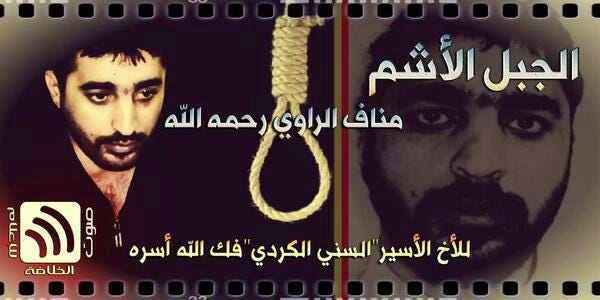
“The Lofty Mountain, Manaf al-Rawi–may God have mercy on him”
In the name of God, the Most Gracious, the Most Merciful
Praise be to God, and prayers and peace be upon the Messenger of God, and upon his family, his companions, and those who follow him.
To proceed [wa ba’ad]:
Long ago, I heard from others that the friendship formed between brothers within the confines of prison walls is unlike any other friendship. It was not until I saw it with my own eyes and suffered the ordeal of captivity that I became fully convinced of the truth of the saying–conveyed to us by our beloved Messenger (may my father and mother be sacrificed for him, peace and blessings be upon him): “Hearing about a matter is not like witnessing it firsthand” [Lit. “The news is not like the direct witness”] (narrated by Ahmad, authenticated by Ibn Hibban and al-Hakim). I spent days and months in Camp Bucca, near Basra, alongside people whom I will never forget for as long as I live–or until I attain martyrdom, by the permission of God Almighty. Among these noble souls was my brother and beloved friend in God, my companion on the journey through Camp Bucca–Abu Abdullah Manaf al-Rawi (may God have mercy on him). I wish to pen a few lines recounting my memories of him.
Before we fell into captivity, God had brought us together in the proud city of Fallujah–in the home of a relative of Shaykh Umar Hadid–in the year 1425 AH [2004 CE]. He [Manaf] was captured months before me, and I was captured after him in Fallujah. After we were transferred from Abu Ghraib to Camp Bucca, God bestowed a great favor upon me by placing me in Compound Five, where the finest of the imprisoned brothers were held. Among them were Shaykh Abu Hammam al-Sa’idi, Hajj Ghazwan al-Tarmiya, our brother Manaf (may God Almighty have mercy on them all), and the virtuous brother Abu Bara al-Dhuluwiya (may God release him from captivity). My relationship with them quickly deepened, especially with the noble Shaykh Abu Hamam al-Sa'idi and the gallant lion Manaf al-Rawi.
I witnessed in our brother Manaf immense courage, zeal, chivalry, and a steadfast defense of the faith, the creed of Ahlus-Sunnah wal-Jama’ah [i.e., Sunni Islam], and the path of truth. I recall the day the Americans tore up the Book of God in our compound–may God Almighty tear them apart!! The prisoners rose as one man to defend the Book of our Lord, the Mighty and Majestic. Four of our finest brothers were martyred, and fifteen others were wounded after the guards opened fire on us. I saw our brother Manaf at the forefront of the brothers, repeatedly crying out “Allahu Akbar.” He remained steadfast for an hour after the shooting began. I witnessed the brothers attaining martyrdom while facing the Crusaders–a small band of brothers chanting, “Allahu Akbar, Allahu Akbar, Allahu Akbar.” I observed in him determination, seriousness in action, and severity towards innovators.
We were held in detention alongside a number of lackeys belonging to the extremist Murji’ah–individuals harboring malice toward the monotheist mujahidin of Ahlus-Sunnah. The brothers used to label them al-Inbitahiyah [loosely, “Submissive Ones”]. I viewed them as khawarij1 toward us yet Murji’ah toward the disbelievers and apostates–to the point where I heard one of them weeping upon seeing a picture of the tyrant Saddam!
I vividly recall one night when our brother Manaf beat one of them severely, drawing blood, to punish him for his insolence toward the muwahidin. He had told a fellow prisoner that the Rawafidh [sectarian slur for Shiites – Rob] in Block Three were better off than the so-called khawarij in this block (referring to the monotheist brothers). I will never forget that stance taken by our brother Manaf, who harshly disciplined that Jahmi.2 Some time after the beating, our brother Manaf told me that the man he had beaten, came to him and said, “You and I are on the same path!” And so this incident transpired so that no one would dare to favor the Rawafidh–people of polytheism and absurd superstitions–over the pure muwahidin, who are the best nation ever brought forth for mankind.
He was a high-spirited brother who deeply loved his fellow believers. I recall that the brothers in Camp Five dug a tunnel to escape the prison. Our brother Manaf was among those who would venture deep into the tunnel to dig. Entering and working in that tunnel was a mission akin to a martyrdom [istishhadi] operation–a form of plunging into the jaws of death–because the soil in Basra is soft and sandy. Every day, a large tanker truck would pass over the tunnel twice to refuel the generators for the disbelievers, while the brothers worked in the tunnel directly beneath it. A group of the Iraqi brothers, Sunni Arabs, would go deep into the tunnel to work. They decided that once they finished digging the tunnel, the first to escape would be the [foreign] Arab muhajirin and the Kurdish brothers, as their plight was more difficult. Only then would the Iraqi brothers–those who actually did the work–would exit. May God reward them greatly among the brothers! And one of those who truly embodied the meaning of nusra [“support”] and brotherhood was our brother Manaf, may God have abundant mercy on him.
Our brother was the spearhead against the disbelievers and apostates in the prison. I remember that after we were transferred from Compound Six (the punishment compound) to Compound Ten, a group of prisoners had been admitted before us, among whom was Mahdi al-Sumayda’i, the head of disbelief and the apostate agent of the Rawafidh. He had appointed himself the leader of the compound and sought to sow havoc and spread corruption–just as he had done at Abu Ghraib Detention Center, where he had fought against the muwahid brothers and sided with a notorious Rafidhi criminal. When we arrived at the compound, as we were thinking about how best to cultivate a generation of monotheist mujahidin within the prison, we decided to tell him that he must relinquish control of the camp and had no right to interfere in any matter. We agreed to send our brother Manaf to convey this message. He went to him and said, “Stay in your caravan and leave this matter.” And thus, God extinguished the sedition of the apostate Sumayda’i through our brother Manaf. Praise be to God!
My last moments with our brother Manaf occurred before God blessed me with release and freedom from prison. I was released before him, and I recall that when my name was called for release, he told me–overcome by the intense sorrow of parting–that he could not bring himself to bid me farewell. He did not even accompany me to the compound’s exit gate but sat in his place.
And so I wished to briefly share some memories of that lion during our time in captivity. As for his courage, boldness, and success in managing the affairs of Wilayah Baghdad [Baghdad Province], these need no elaboration, for the bloody days in Baghdad bear witness to his efforts. Who among us has not heard of Bloody Tuesday, Bloody Wednesday, Blood Thursday, etc? Indeed, his shrewd wit and intelligence in dismantling the Ministries of Polytheism and Apostasy–and dealing with the apostates therein–bear witness that our departed knight truly made the polytheist Rawafidh taste tides of devastating torment!
After our brother Manaf was captured for the second time, the tyrants sentenced him to death. He was subsequently executed–killed in captivity. As recorded in a hadith classified as sound: “A killing in captivity wipes away every sin it touches.”3 May God have mercy on him–a brother, a friend, and a companion–and peace be upon his soul among the eternal. I ask God Almighty to accept our brother Manaf–and all those slain on this path–into the ranks of the martyrs, and to join us with them as martyrs who advance and do not retreat. For those who wish to read more about the virtues of Abu Abdullah Manaf and see how the eyes of men wept for him, let them read what was written by Imam Shaykh Abu Musab al-Zarqawi–may God have mercy on him–in an article titled “When Men Weep” [‘Indima Yabki al-Rijal].
Written by:
Abu Abdullah al-Sunni al-Kurdi
“The suicide bombers were Arabs, and the bombings of the Ministries of Foreign and Finance cost $150,000.”
Interview Introduction
The al-Iraqiya channel conducted an extensive interview with Manaf al-Rawi–the terrorist of the Wahhabi Al Qaida organization who was given the title “Wali [Governor] of Baghdad”–in which he confessed to joining the terrorist organization, personally carrying out a number of criminal operations, or issuing orders for their execution.
Rawi confessed that he planned the bombings of the Ministry of Foreign Affairs and the Ministry of Finance, saying: “The explosive materials used in the operation came from Mosul, and even the suicide bombers–most of them [foreign] Arabs–come from Syria via Mosul. For any operation entrusted to me for execution, I study it, determine its costs, and send a request for the necessary funds to carry it out, and indeed the money arrives via regular mail in dollars. The operation on the Ministry of Foreign Affairs and the Ministry of Finance cost a total of $150,000.”
Below is some of what was contained in the confessions of the terrorist Manaf al-Rawi:
I was born in Moscow in 1975. My father was an officer and was studying engineering before he was martyred in the Iran war in 1980. I returned to Iraq after that, and my mother took charge of my affairs along with five of my siblings, two of whom are older than me. I lived in the Zayuna area and reached the sixth preparatory class in my studies, but I was weak in English. I served in the military on secondment, and after that I was appointed to the Ministry of Industry and Minerals, working as a clerk in the Northern State Fertilizer Company until the fall of the regime in 2003. I was living a normal life and had no problems whatsoever. In 2000, we left the Zayuna area to take advantage of renting out our house, and we moved to the Dura area in the Health Quarter. I was unmarried at the time, then I got married in 2004 and have one child who is a year and a half old.
Interview
While carrying out a bombing operation, do you think about the children of martyrs who fall as a result of these acts, and do you watch the aftermath of explosions on television screens?
I don’t often watch television.
In the Zayuna area where you used to live, a mix of Sunnis and Shiites, did anyone harass you because of your sectarian affiliation?
No.
And when you moved to the al-Sahah Quarter, how was it?
I was arrested by the Americans in 2004 in connection to the events of Fallujah, where I participated, and I remained in prison for three and a half years, transferred between the prisons of Abu Ghraib, Bucca, and the Airport.
How did you get to Fallujah?
Many people were involved with the Fallujah events at that time, and I knew a person there from the Rawah area, whom I met after the fall of the regime. He suggested that I fight against the Americans. My grew closer to him, and I would visit him from time to time.
When the regime fell, where were you?
I was in the Zayuna area in Baghdad, where I live, while my family was in Anbar. The Americans subsequently entered Iraq, and I wanted to fight the Americans, an impulse that existed among many young people, even in the mosque where I used to pray.
As young people, did you talk about fighting the Americans? Was there a specific organization you were affiliated with, and where did you get weapons?
No, we had no organization. There was a shelter with many weapons left behind by the Fedayeen Saddam, which they abandoned, and the young people seized them.
What happened after you seized the weapons?
Nothing happened in the area, and I met, as I mentioned to you earlier, a person from Rawah.
Where did you meet him?
Through his relatives in Zayuna in 2003. We talked about fighting the Americans, and he told me about the existence of a fighters’ camp in Rawah called Sahl al-Amir, which had 100 [foreign] Arab fighters and a few Iraqis. The site was bombed by the Americans in the sixth month [i.e., June] of 2003, and approximately 86 people died, while a portion of them survived, including a person named Ghassan al-Rawi. “Muhammad Abu Azzam” put to me the matter of fighting the Americans, and after we met at my friend’s house in Zayuna, I expressed my interest and went to Rawah, where I met Ghassan and another [foreign] Arab named Abu Muhammad al-Lubnani.
Who is this Abu Muhammad al-Lubnani?
He is from outside the camp that was bombed. During that period, there was nothing declared, no declared organization.
Was Abu Muhammad al-Lubnani connected to an organization outside Iraq?
I found out later that he had been in Afghanistan.
What happened after you met Abu Muhammad al-Lubnani and Ghassan al-Rawi, and how many were you?
Approximately twenty people. After that, I participated in an operation against the Americans between Rawah and Anah.
How did you find out that there was something called Al Qaida in Iraq?
After my relationship with Abu Muhammad al-Lubnani strengthened, I became very close to him. He used to frequent Fallujah and meet with Abu Musab al-Zarqawi and another person named Abu Anas [al-Shami]. During that period (the end of 2003), they announced a new organization by the name of Jama’at al-Tawhid wal-Jihad.
Where were Abu Anas, Abu Musab, and Abu Muhammad?
Abu Anas al-Shami and Abu Musab were present in Fallujah, while Abu Muhammad was outside the city.
The American forces besieged Fallujah. Were Abu Anas al-Shami and Abu Musab al-Zarqawi there in the city?
The Americans could not enter the city, so the matter turned to negotiations.
Was the negotiating delegation actually conducting the negotiations, or did they contact Abu Musab and Abu Anas?
The negotiating delegation was from another party, and they had no contact with Abu Musab and Abu Anas.
Who was directing you in battle?
Each person managed an area and its fighters, and each area had a responsible person.
After the battle ended, where did you go?
I returned to Baghdad because the battle was over.
Where did your meetings take place?
Most of them in Fallujah.
Do you know how the Americans identified you?
There was a house in Fallujah where a person was arrested who confessed during interrogation to my participation with him in operations. He was being watched by the Americans via aircraft. I had gone to this house, and when I left heading for Baghdad, an American force arrested me.
Did they charge you with carrying out operations against them and participating in the Battle of Fallujah, and when did they release you?
No, they did not have information about my relationship with Abu Muhammad al-Lubnani. I was imprisoned for three and a half years and was released in November 2007. I went to my uncle’s house in al-Ghazaliya, and after that I met my family and rented a house for us in the al-Khadra quarter.
Did you have the money to rent a house?
Yes, I was employed, and my salaries were waiting for me at the department.
How did you contact Al Qaida after your release from prison, and how did these operations develop?
I contacted the organization through a person named Abu Muadh. I had kept his phone number, knowing that he was in contact with those groups there. I called him, and he connected me to the responsible persons. There was a person responsible for Baghdad called Hajji Abdul-Wahid. I met him in the Mansur District in his private car (a Corona). He had an appointment with Abu Muadh, and indeed we met and stayed in the car. I asked him to introduce me to Shaykh Abu Hamza after I came out of the detention center. He said to me, “I will write to the group.” After a few days, an appointment was set, and I met him two weeks later. I received from him a letter from Abu Hamza, whose position was Minister of War–in the terrorist organization, that is–in the year 2007, and I met him.
Do you know Abu Hamza?
Yes, I met Abu Hamza. He had two kunyas: Abu Ayyub and Abu Hamza. After that, I met a person in Samarra named “Abu al-Bashir.” Throughout the meeting, he spoke with me about the nature of the situation. I learned then that he was the coordinator for the entire country. He said to me, “Stay with Hajji Abdul-Wahid until you get to know the situation, because you have just come out of prison.” I stayed with Hajji Abdul-Wahid until mid-2008. Then Abu Hamza appointed me as deputy to Hajji via mail. They had fixed appointments every week to deliver and receive mail, and that appointment was on Saturday.
I did not participate, until I was appointed in place of Abdul-Wahid, as he was an elderly man who had encountered problems in Baghdad with members of the organization, such as Abu As’ad. Then I became “Emir of Baghdad” or “Wali of Baghdad.”
How was the city of Baghdad divided, and what is the identity of the fighters in your organization?
Baghdad was divided into three sections. The first was overseen by Abu As’ad, who was killed by the Americans in the al-Adhamiya district. The second section was South Karkh, which included the Dura, Saydiya, Bayya, and Airport districts, as well as all areas to the left of the airport. This was under the responsibility of a man called Abu Yassin, who is currently detained. As for the areas to the right of the airport–Amiriyah, University Quarter, Yarmouk, Mansur–they are called North Karkh, and the person responsible for them is Abu Ibrahim.
How do you manage the work?
I held meetings. I would set the appointment with the members of the group. During that period, there was no military commander in Baghdad. Then Hatim al-Askari came to me from Anbar in 2008, and we began carrying out operations.
From where are suicide bombers brought to Baghdad?
From Mosul. There was a man named Abu Ja’far who transported the suicide bombers.
How did you target the churches?
Using improvised explosive devices. We targeted six churches in one day. The plan was for every two persons to target three churches, with North Karkh and South Karkh targeting two churches each.
What are the mechanisms for carrying out operations?
We targeted the Husayniyas in New Baghdad and al-Zafaraniya, and after that, we struck the ministries. The first were the Ministries of Foreign Affairs and Finance. The operation was planned to be carried out using four cars, but two of them were seized, so it was executed with two cars. The plan was to target the Ministries of Finance, Foreign Affairs, Justice, and the Baghdad Governorate all on the same day. However, for the stated reason, the bombings of the Ministry of Justice, the Governorate building, courthouse building in al-Zawra, and the Judicial Institute were postponed. One of the cars was heading to the media network headquarters, but it was discovered by personnel at a checkpoint. After that, hotels were targeted before I was arrested after the elections.
How are targets determined?
The orders come from Abu Hamza to target specific objectives. It is not my duty to determine those targets, nor is it Baghdadi’s. My role lies in execution. If I am unable to do so, I write to them informing them of my inability to execute. Regarding the operation to bomb embassies, I knew about it, and they asked me to carry out two operations against the Jordanian and Chinese embassies, but I could not execute them, and I informed them of that.
What is the reason for choosing certain embassies over others?
This relates to specific matters based on a particular vision. For example, targeting the Jordanian embassy is based on the apparent hostility and Jordan’s positions against Al Qaida.
Why were those operations not stopped after your arrest?
Because the execution and supervision of operations are not solely entrusted to me, so when I was arrested, those operations continued against the planned targets. There is a person named Hatim who has managed them after me.
Where and how are the suicide bombers equipped with car bombs and explosive belts?
In Baghdad, there are houses rented for this purpose–no more than three or five–where cars bought from markets or dealerships are rigged with explosives, and suicide belts are prepared. These houses were located in the Mansur, Husayn, Jihad, University, and Khadra Districts, but they have now been exposed by security forces. Whenever their use is discovered, we abandon them and rent others.
What are the material costs of carrying out a terrorist operation? Take, for example, the operation on the Ministry of Foreign Affairs. How was the car purchased and rigged?
The Ministry of Foreign Affairs operation alone cost $35,000, and I funded it. The barrels placed in the car were purchased from the market, and the explosives used in the operation came from Mosul. Even the suicide bombers–most of them [foreign[ Arabs–came from Syria via Mosul, especially given the difficulty of entering and infiltrating through the Anbar border. Generally, for any operation I'm assigned to carry out, I study it, determine its costs, and send a request for the necessary funds. The money then arrives via regular mail in dollars. The Ministry of Foreign Affairs and Finance operation together cost a total of $150,000.
What type of explosive materials enter from Syria?
There is no ready-made explosive material prepared for detonation that comes from Syria. Rather, agricultural urea is sent from Syria, and then we mix it with other explosive materials to make it ready with a very high explosive power.
How many assassination and slaughter operations did you personally carry out?
I didn't carry out any beheadings or assassinations, as those were the responsibility of the organization's sub-branches.
What are the reasons for bombing churches, mosques, and Husayniyas [Shiite temples]?
The reason for bombing churches is the ban on Muslims from building minarets in Western Christian countries. Just as they prevented mosques, we prevent them from practicing their rituals and ceremonies. The target here is not Iraqi Christians as individuals, but rather the religion, its rituals, and its buildings. As for targeting Husayniyas, it is because they are Shiite. The reason for targeting Harith al-Ubaydi is that he declared his hostility to Al Qaida on more than one occasion.
Who are the members of the Al Qaida organization? And how are the salaries of its members secured?
The members are from multiple categories, all of them unemployed. If I have money available, I distribute salaries to them based on the number of their family members. For example, I would give an amount of $200 to someone with a family of five children.
Did you have connections with people working in the security agencies or state departments?
There were no such connection during the period I was working.
How is a suicide bomber who enters the country prepared and delivered to the sites to be bombed?
Hatim is the person responsible for preparing this individual, bringing him from Mosul to Baghdad or any other area. He is responsible for surveying the location and gathering sufficient information about it, along with the suicide bomber, to form a complete picture of what he will do. He also forges an identification card for him to facilitate his movement between regions and cities.
Are there any distinctive, high-profile operations that you carried out?
Yes, the Airport operation. I planned it for a month and executed it completely. I stopped two American vehicles and killed those inside them, numbering seven people. I was supposed to capture them, but they were killed during the operation.
Did you kill journalists?
We did not do that during the period I was working.
Did you plan to carry out operations in the near future?
Yes, it was planned. Over the next six months, among the orders we planned to carry out was the targeting of two predominantly Shiite areas in response to the statements made against Caliph Abu Bakr al-Siddiq, as well as an operation against the preacher of the Kadhimiya shrine. However, my arrest halted these operations.
Do you think that your arrest and the killing of Abu Ayyub al-Masri and Abu Umar al-Baghdadi negatively affected the organization’s activity?
Yes, for they had a significant impact on the organization.
Do you think the organization will continue to operate inside Iraq, and do you see the Iraqi people accepting your actions?
The fact that no one accepts our actions is irrelevant to whether we continue our work or live inside Iraq. There are no Iraqi tribes or regions that want our presence among them or want to support us. It is true that this was the case in the past, but now it is not the case for several reasons.
Which leaders of Al Qaida did you meet?
I met Abu Musab al-Zarqawi once in 2004. The occasion was the events in Fallujah and how they were being managed. I also met Abu Muhammad al-Lubnani, Abu Anas al-Shami, and Umar Hadid. All of them were killed. As for Baghdadi, I never met him.
Are there connections of the organization outside Iraq?
I don’t know.
Did you consider the consequences of the terrorist operations and decide to stop out of regret, conscience, or the injustice done to innocent people?
I don’t think my regret would be of any use now
The Khawarij were an extremist sect of early Islam who held to a number of highly unorthodox, or even heretical, beliefs and practices, most infamous of which was the liberal excommunication of Muslims. Since the demise of the original Khawarij, their name has become a term of abuse in Islamic history and politics. The term is often used against Islamic State, but here we see the pro-IS author use it against his rivals in prison.
Meaning a follower of al-Jahmiyah, referring to the doctrine of the eighth-century Islamic theologian Jahm bin Safwan. His most known teachings are that the divine attributes of God are strictly metaphorical; that the Quran is created, rather than eternal; and that Heaven and Hell are temporary realms. The exact content of his teachings is secondary to that fact that hardline Salafis, like Wahhabis, use Jahmi as a term of abuse, as is the case here.
The original Arabic reads: قتل صبر لا يمر على ذنب إلا محاه