South African Destabilization - UN (1989)
FROM THE ARCHIVES: The Economic Cost of Frontline Resistance to Apartheid

NOTE: My humble thanks to Sina Toosi for first posting this document and sharing the pdf with me.
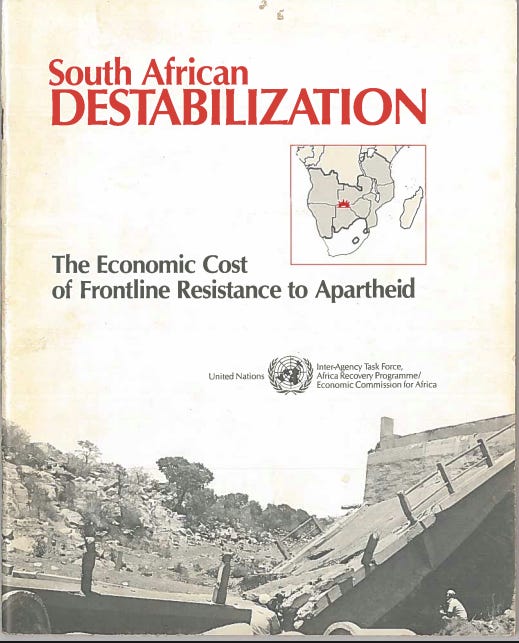
In 1989, the United Nations Inter-Agency Task Force for the Africa Recovery Programme published a report on the enormous costs of Apartheid South Africa’s regional aggression, through either direct or proxy warfare. The parallels to modern Israel are incredibly eerie. The Apartheid regime pursued a “total strategy” of destroying all possible opposition to its reign in Southern Africa. This involved:
the coordination of internal and external strategies covering four sectors-economic, military, diplomatic and political. The regional objective is to maintain a dependence by neighbouring states which will be economically lucrative for South Africa and will simultaneously keep these states politically submissive. These states would also act as a bulwark against the imposition of international sanctions against apartheid, since such sanctions would hurt them as well. It is not South Africa’s objective simply to militarily destabilize those states which have the geographical misfortune to share its borders, but rather to use destructive methods or “disincentives” as well as “incentives” to “persuade” them that their interests lie with Pretoria, rather than in opposition to apartheid. (9) [Emphasis mine]
A South African “Abraham Accords” of sorts… Near-genocidal violence against the targeted societies was essential to this strategy. The main targets were Mozambique and Angola, though the following states were also victimized by South African aggression: Namibia, Zimbabwe, Malawi, Zambia, Tanzania, Lesotho, Swaziland, and Botswana. Some of these states, like Zimbabwe and Tanzania, were targeted specifically for their anti-colonial solidarity with Angola and Mozambique (just as Iran, Lebanon, and Yemen have been targeted by Israel). The costs were devastating: “The number of dead has reached 1.5 million, over half of them children under five who would have lived had it not been for war. Half the populations of Mozambique and Angola have been displaced from their homes at least once by the war, or rely on emergency food aid for their survival. The number of wounded, maimed, mutilated and malnourished, the future effects of disrupted education and, in some cases, of children traumatized by a particularly brutal war, are more difficult to quantify.” (4) The resemblance to Israeli (and increasingly Emirati) fascism in the Middle East speaks for itself.
